
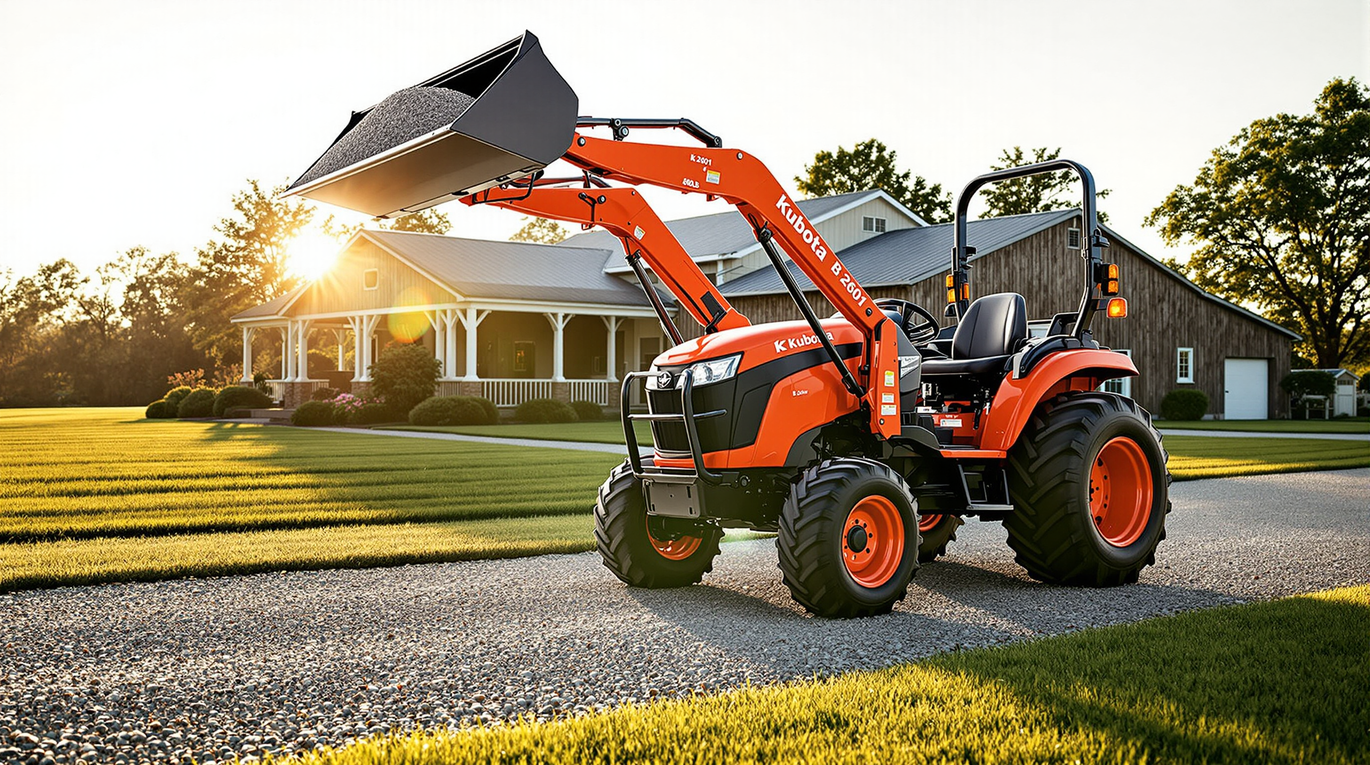
Walk into any Kubota dealer and you'll hear the same pitch: 25.5 horsepower, 1,808 lb rear lift, three-range hydrostatic transmission, and zero-percent financing. What you won't hear is what the B2601 actually costs to own once the financing paperwork is signed.
After years of helping B2601 owners source replacement parts, we've built a clear picture of the ownership cost dealers don't put on the brochure. The tractor itself typically runs in the mid-to-high teens (US$) depending on configuration. The first five years of ownership add roughly $3,500–$4,200 in dealer-priced parts and service — or around $1,300–$1,600 if you do the work yourself using aftermarket parts matched to the OEM part numbers. That gap — over $2,000 across five years — is what this article is about.
We're not going to repeat Kubota's spec sheet. Instead, we'll walk through the parts you'll actually replace, the OEM part numbers to write down before you sign anything, and the issues real B2601 owners report on TractorByNet, OrangeTractorTalks, and ConsumerAffairs.
The 5-Year Parts and Service Cost — Itemized
Here's what five years of routine service costs on a B2601 at typical homestead intensity (about 200 hours per year). The DIY column assumes you do the work using aftermarket parts cross-referenced to the OEM part numbers below; the Dealer column reflects typical U.S. Kubota dealer service rates as of 2026. Prices are ranges because they move — the part numbers are the constant.
| Service / Part | OEM Part Number | Interval | DIY Cost | Dealer Cost |
|---|---|---|---|---|
| Engine oil + filter (15W-40) | HH150-32094 (filter) | Every 200 hr | $25–$35 | $140–$180 |
| HST hydraulic filter | HH660-36060 | Every 200 hr (first at 50 hr) | $9–$20 | $90–$120 |
| Hydraulic return filter | HH6C0-37710 | Every 200 hr | $20–$30 | $90–$120 |
| Fuel filter | 15521-43160 | Every 400 hr | $10–$20 | $80–$100 |
| Air filter (outer) | 6A671-75090 | Every 400 hr | $25–$40 | $70–$95 |
| Air filter (inner) | 6A671-75100 | As needed | $20–$30 | $55–$80 |
| Super UDT2-spec hydraulic fluid (4 gal) | 70000-40201 (OEM ref) | Every 400 hr | $95–$130 | $250–$300 |
| Battery (Group 24F, 710 CCA) | Generic Group 24F | Every 4–5 yr | $120–$160 | $210–$260 |
| 5-year totals (≈200 hr/yr) | — | — | ≈ $1,300–$1,600 | ≈ $3,500–$4,200 |
⚠️ Two filters, not one. Unlike the BX series with its single combined filter, the B2601 has both an HST filter (HH660-36060) AND a separate hydraulic return filter (HH6C0-37710). Both are due at every 200-hour service. Missing one is the most common B2601 maintenance mistake — and the one your dealer hopes you don't catch.
How the OEM numbers save you money: you don't have to buy at the dealer counter to use them. Every number in that table is a matching index — quality aftermarket suppliers list their filters and fluids against these exact OEM references. Search the OEM number, verify the cross-reference, and the same 200-hour service that invoices at $250+ from a dealer costs a fraction in parts.
Five Issues Owners Report That Dealers Skip
These aren't recalls. They're the recurring complaints across owner forums — things your salesperson knows but won't volunteer at the closing desk.
1. The HST treadle pedal is stiff for the first 50 hours
Multiple owners on OrangeTractorTalks describe the reverse pedal as hard and unnatural early on. Dealers will say it loosens with break-in — true — but it stays stiffer than an L2501's even after 50 hours. If you're coming from a BX or a competitor, expect a learning curve. The optional foot step (Kubota part 70000-78940) noticeably improves modulation.
2. ROPS bolts loosen and the bar starts to rattle
The roll-over protection structure on a new B2601 commonly works its bolts loose within the first 50 hours — owners report rattling and, in the worst cases, the bar folding unexpectedly when stowed. The fix is a 30-second check: torque the four ROPS pivot bolts to spec (consult your operator's manual) in your first month of ownership.
3. Loader doesn't sit level — and the dealer 'fixes' don't hold
The single most common B2601 complaint: the loader bucket sits nose-down 5–10 degrees on flat ground. Dealers usually respond with shim adjustments that don't hold. The real fix is loader cylinder rod-end alignment — a 20-minute job once you know it — but many dealers take three or four warranty visits to get there. Document the issue with photos on day one.
4. Fuel starvation around 100–200 hours
Some units develop hard starting and stalling around the 100–200 hour mark. Replacing the fuel filter (15521-43160) solves it about half the time. The other half: a loose hose clamp at the filter head, or debris at the tank pickup. If your B2601 starts and then dies after 10–30 seconds — filter first, then re-clamp the fuel hose connections before blaming the injection pump.
5. Quick coupler failure kills both loader and 3-point
The hydraulic quick coupler has a known failure mode where one internal seal lets go and disables the loader and the 3-point hitch simultaneously. The repair part is cheap — under $40 — but diagnosis time is what eats the bill. If you lose both hydraulic circuits at once, this is almost always the cause. Don't pay for three hours of diagnosis.
When the B2601 Is the Right Tractor (and When It Isn't)
This is the part dealer salespeople aren't incentivized to give you straight.
Buy the B2601 if you have:
- 4 to 10 acres of mixed property — yard, light woods, gravel drives
- Mowing sessions under 4 acres of grass
- Snow clearing under 2,000 ft of driveway with a front blade or rear blower
- Light loader work — mulch, gravel, firewood, light landscaping
- Tight gates and trail clearances under 60 inches
Buy something larger (L2501 or L3301) if you have:
- More than 10 acres or any commercial-scale work
- Heavy loader work — rocks over 500 lb, pushing dirt, regular pallet handling
- A backhoe as a primary use case (the B2601 backhoe is residential-grade)
- Plans for a cab — the B2601 has no factory cab option
- Implements over 1,800 lb at the 3-point hitch
"I have 9 hours on my B2601 and I like it. The most surprising thing for me is the stiff ride. It's like sitting on a brick." — B2601 owner, OrangeTractorTalks
That stiff ride is structural, not a defect: B-series compacts have no suspension and rely on tire deflection and seat springs. Fine for smooth lawns; if you're spending six-hour days on rough ground, look at the L-series.
Where to Buy B2601 Parts (and How to Not Overpay)
Once the warranty is out, the dealer parts counter becomes the biggest line item in your tractor budget — dealer markup on maintenance parts commonly runs 60% to 110% over wholesale.
The smarter route for routine items — filters, fluids, batteries, belts — is aftermarket parts matched by OEM part number. The OEM number is the quality contract: a reputable aftermarket supplier cross-references its parts against those exact numbers and builds to the same fit and filtration spec. What you're skipping isn't quality — it's the dealer's margin.
Two rules keep you safe when buying aftermarket:
- Match by OEM number, not by photo or description. If the listing doesn't state the OEM cross-reference, skip it.
- Check your serial range. The B2601 had a minor mid-production revision that changed two filter mount points — confirm the number against Kubota's parts diagram for your serial before ordering.
For hydraulic fluid, stay with Super UDT2-spec fluid (OEM reference 70000-40201 or a certified equivalent) — the HST clutch packs are designed around it. That's a spec requirement, not a brand requirement.
Frequently Asked Questions
How many hours will a Kubota B2601 last?
Maintained on the recommended schedule, a B2601 typically reaches 4,000 to 6,000 hours before major engine work. The D1105 three-cylinder diesel has a long industrial service record. Hydraulic longevity depends almost entirely on filter discipline — owners who skip the 200-hour service see HST clutch wear by 2,500 hours.
What is the most common B2601 problem?
By a wide margin: the loader sitting nose-down. It's reported across forums and review sites more than any other complaint. The fix is loader cylinder rod-end adjustment, not bucket shimming. Shopping used? Check loader level on flat ground as part of your inspection.
Is the Kubota B2601 still in production?
As of this writing the B2601 is a current model with full warranty support and parts availability, with MSRP typically landing in the mid-to-high teens depending on loader and configuration. Confirm current pricing with a dealer quote — and use this article's parts math when you evaluate it.
Can I do my own B2601 hydraulic filter change?
Yes — and you should. The 200-hour HST + return filter change takes about 45 minutes with basic tools and 4 gallons of Super UDT2-spec fluid, and saves roughly $200 versus dealer service. The two numbers you need: HH660-36060 (HST) and HH6C0-37710 (return). Don't substitute generic hydraulic fluid — UDT2 spec is what the clutch packs are designed for.
How much does it cost to keep a B2601 running for 5 years?
Roughly $1,300–$1,600 in DIY parts and fluids using OEM-matched aftermarket components, or $3,500–$4,200 with all service at the dealer, at typical 200-hour-per-year usage. That excludes major repairs (uncommon under 2,000 hours) and implement maintenance.
Bottom Line
The Kubota B2601 is one of the best compact tractors made — that part of the dealer pitch is true. What's missing from the showroom conversation is the realistic ownership cost, the five recurring issues above, and the fact that your service bills drop by more than half when you match parts by OEM number and turn a wrench yourself.
If you're on 4 to 10 acres, doing homestead work, and willing to do basic maintenance, the B2601 will reward you for fifteen years. If not, walk back across the showroom and look at the L-series.
Either way, write these part numbers down before you leave: HH660-36060, HH6C0-37710, 15521-43160, HH150-32094, 6A671-75090. Tape them inside the operator's manual. Future you says thanks.
Ready to price a service kit? Search any of these OEM part numbers at disenparts.com — aftermarket parts cross-referenced to genuine Kubota numbers, shipped fast from U.S. stock.


